

Can AI discover new science?
Finding cancer drug targets with Codex

AI models are getting better and better — can they actually discover new science?
To test this I asked Codex to look for new cancer drug targets, focusing on synthetic lethality, which describes the phenomenon where combined loss or inhibition of two genes or pathways is deadly, but loss of only one is tolerable.
The canonical synthetic lethal interaction, discovered in 2005, is between mutations in BRCA1/2 and inhibition of PARP, an approach that’s now approved for 8 indications in 4 cancer types: ovarian, breast, pancreatic and prostate. Cancers deficient in BRCA1/2 are exquisitely sensitive to PARP inhibition, because PARP inhibition generates deadly DNA double strand breaks that can’t be repaired in BRCA1/2-deficient cells.
Synthetic lethality
Loss of two genes or pathways is deadly, but loss of only one is tolerable. Cancers delete or mutate many genes, so it’s useful to look for synthetic lethal interactions, where inhibition of a different protein can kill them (while sparing normal cells).
PARP inhibition in BRCA-deficient tumors is still the only synthetic lethal interaction approved for the treatment of cancer, but recent data for the PRMT5-MTAP interaction, which generated unprecedented 92% objective response rate (on top of RAS inhibition) in pancreatic cancer has brought new light to the field.
The context I gave Codex was DepMap, a huge genetic database of many different genome-wide CRISPR screens, as well as individual papers that did genome-wide synthetic lethality screens (like this one). These experiments systematically delete genes using CRISPR to discover essential pathways that cells can’t live without, and, since cancer cells naturally lose tumor suppressors, the data can also reveal synthetic lethal pairs. Codex compared 115 tumor suppressors against 18,443 CRISPR targets, for a total of 2.12 million combinations, and found three genuinely interesting, novel synthetic lethal interactions:
1. Inhibition of the histone chaperone, ASF1B, should kill cancer cells deficient in the DNA methyltransferase, DNMT3A (DNMT3A is often lost in adult myeloid cancers).
2. Inhibition of the membrane-bound transcription factor, MYRF, should kill cancer cells deficient in the chromatin regulator, BAP1 (BAP1 is often lost in kidney cancer, mesothelioma, and uveal melanoma).
3. Inhibition of the transcriptional regulator, HCFC1R1, should kill cancer cells deficient in the DNA repair master regulator, ATM (ATM is often lost in endometrial cancer and melanoma).
These interactions are shown in the following table, alongside established synthetic lethal pairs as positive controls. A score of 0 is the median effect for non-essential genes; -1 is the median score for a pan-essential gene. The key number is the delta, which shows the fitness difference between target loss in wildtype vs. mutant/deleted cells. A good synthetic lethal interaction is one with a wide delta, where target inhibition spares normal cells while killing cancer cells. The new interactions uncovered by Codex have deltas that are comparable to established interactions.
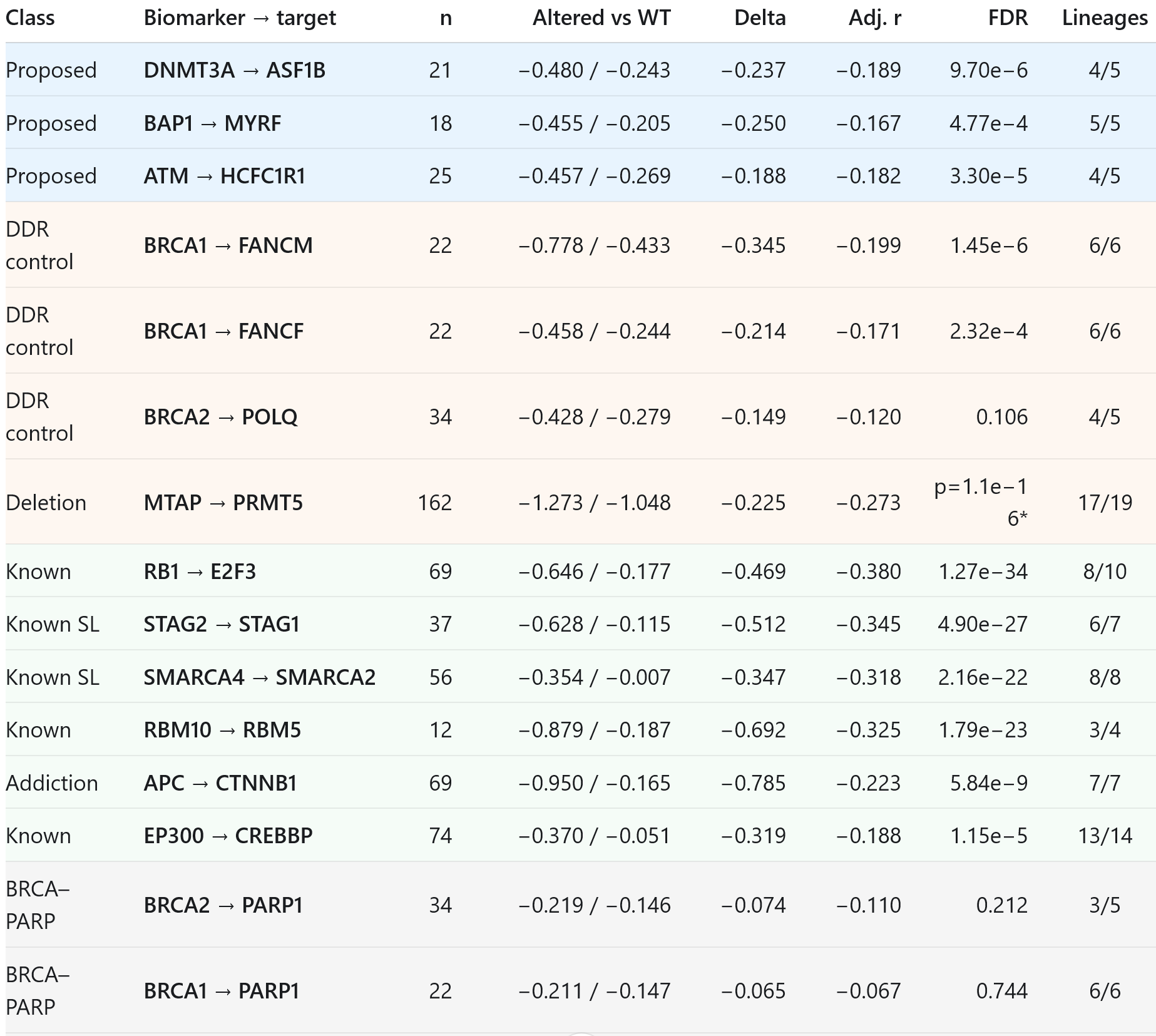
BRCA-PARP is actually not a good positive control here, because the interaction depends on PARP inhibition (and consequent trapping) rather than genetic loss — which highlights a drawback of this approach.
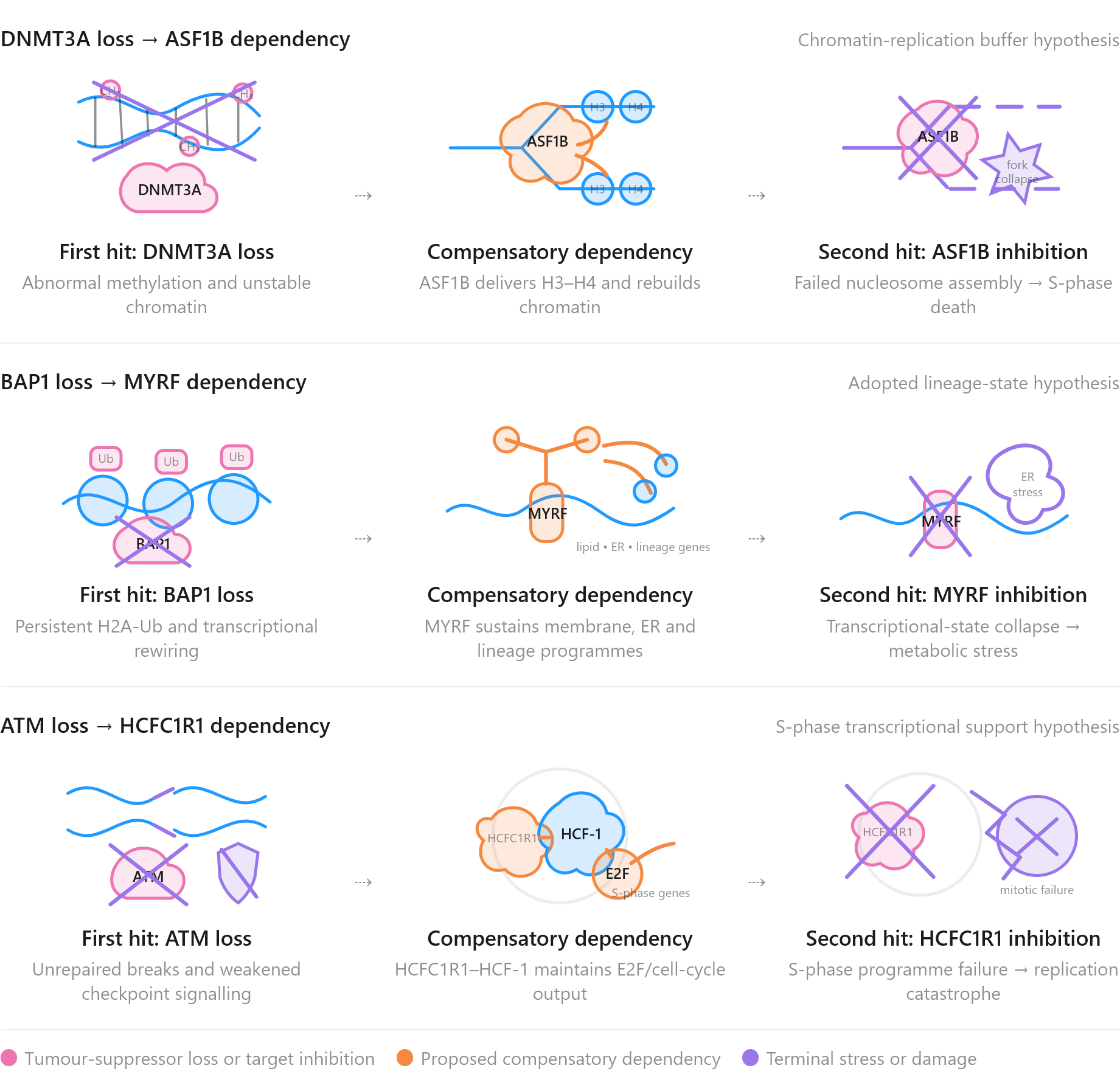
What about the plausible mechanisms by which these synthetic lethal interactions might occur?
For DNMT3A-ASF1B, since DNMT3A deficiency disrupts chromatin, and since ASF1B regulates histones during replication, it might be that ASF1B becomes essential for maintaining DNA replication forks in DNMT3A-deficient cells.
For BAP1-MYRF, since loss of BAP1 can hyperactivate MYRF and its transcriptional network, BAP1-null cancers might become reliant on MYRF’s target genes.
For ATM-HCFC1R1, since ATM-deficient cells suffer chronic replication stress, inhibition of HCFC1R1 might disrupt the HCFC1R1-dependent transcriptional program needed for healthy S phase progression.
This analysis is imperfect — experts tell me that DepMap doesn’t have the best data for target discovery (though I don’t think there’s a better one). The next steps would be validation of these hits in the lab using cell lines and pharmacological inhibition (none of the targets have inhibitors yet, either). But with the rate of progress in AI and the rise of labs that can do experiments like these autonomously — like Ginkgo Bioworks — it might not be long before we have 1-person biotech companies.
This post is sponsored by Consensus, the AI agent that helped me with the research. Consensus now has >2.5 million monthly users. If you’re a doctor, try Medical Mode to query guidelines and the top medical journals. If you’re doing research, Consensus has access to 220 million peer-reviewed papers, and has deals with 6 top publishers to access full texts (even behind paywalls). You can use my link for a free trial!

Thank you for reading, let me know what you think!
nice...
I’m sending this to my medical oncologist at Anschutz ( I’m a phase 2 trials patient for Ippi/nivo). We just talked about the coalescing of large data sets for research/ doctors to use in patient care.